

Introduction
Fitness is a broad concept that refers to the state of physical health and well-being achieved through regular physical activity, balanced nutrition, recovery, and healthy lifestyle habits. It includes multiple components such as muscular strength, cardiovascular endurance, flexibility, body composition, and mental resilience. Although today fitness is often associated with gyms, workout programs, and digital tracking devices, its roots go far deeper into human history. The pursuit of physical fitness has existed as long as humanity itself, evolving alongside culture, science, warfare, and societal development.
To fully understand fitness, it is important to explore not only its modern form but also its historical evolution and the changing perception of the human body across different eras.
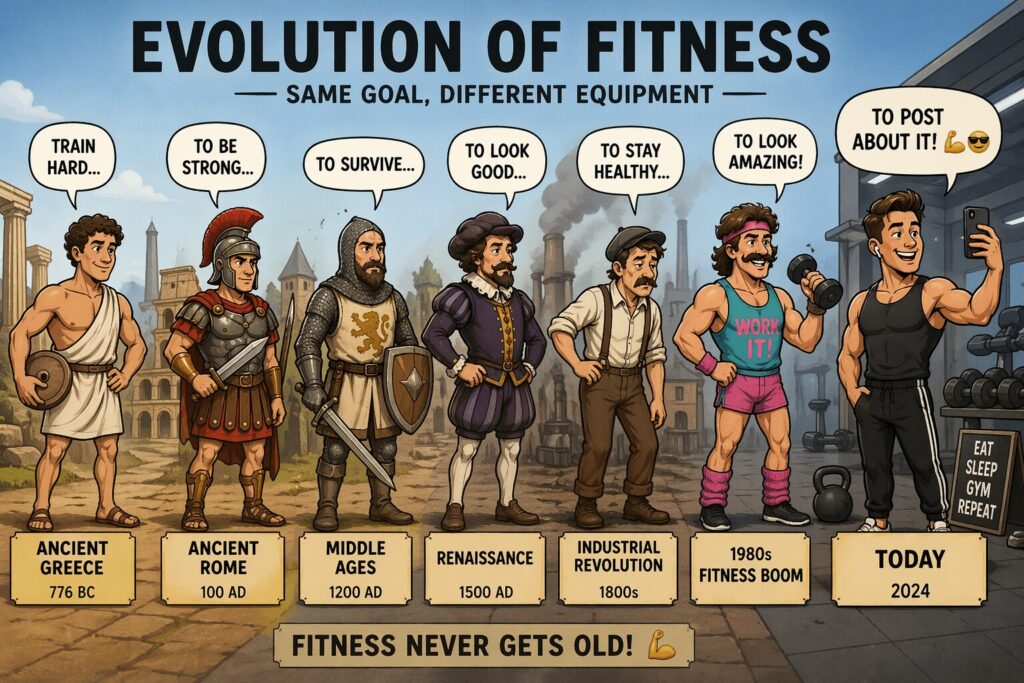
Ancient Civilizations and the Origins of Fitness Culture
In ancient civilizations, physical fitness was not optional, it was essential for survival, warfare, and daily life.
Ancient Greece
Ancient Greece is often considered the birthplace of structured physical training. The Greeks believed in the concept of “kalokagathia”, which represented harmony between the body and mind. Physical fitness was deeply connected to philosophy, education, and civic duty.
The gymnasium was a central institution where young men trained in running, wrestling, jumping, discus, and javelin throwing. The Olympic Games, first recorded in 776 BC, were a celebration of physical excellence and competition. Athletes trained systematically, often under the supervision of professional trainers, and their physiques were considered a symbol of beauty and discipline.
Ancient Rome
The Romans adopted many Greek fitness traditions but adapted them for military efficiency. Physical training focused heavily on endurance, strength, and discipline for soldiers. Roman legions were known for their strict physical conditioning, including long marches with heavy equipment, combat drills, and swimming.
However, unlike the Greeks, Romans gradually shifted toward spectator sports such as gladiatorial combat, where physical fitness was more about entertainment and performance than personal development.
Ancient Egypt and Other Civilizations
In Egypt, physical fitness was linked to labor, military strength, and ritual performance. Wall paintings show activities such as swimming, archery, wrestling, and rowing. Similar traditions existed in China and India, where martial arts, yoga, and breathing exercises were developed to strengthen both body and mind.
Middle Ages: Decline and Practical Physical Activity
During the Medieval period in Europe, the structured approach to fitness declined significantly. Society became more focused on agriculture, feudal systems, and survival. Physical activity still existed, but mostly in the form of manual labor, hunting, and military training for knights.
Knighthood culture required training in horseback riding, sword fighting, and endurance in armor. However, there was no standardized concept of fitness as a health practice. The body was often seen in religious terms, and excessive focus on physical development was not widely encouraged.
Despite this, physical competitions such as jousting tournaments and archery contests remained popular among the nobility, maintaining some level of athletic tradition.
Renaissance: Rediscovery of the Human Body
The Renaissance period marked a major shift in how the human body was perceived. With the revival of art, science, and philosophy, there was renewed interest in anatomy, movement, and physical education.
Artists such as Leonardo da Vinci studied human muscles and proportions in great detail, contributing to a better understanding of biomechanics. Physical education began to re-emerge, especially in the form of fencing schools and military training academies.
Gymnastics also began to develop as a structured discipline, particularly in Germany and Sweden, where educators started to design systematic exercise programs for schools. This period laid the foundation for modern physical education systems.
Industrial Revolution: The Rise of Sedentary Lifestyles
The Industrial Revolution dramatically changed human lifestyles. People moved from rural, physically active work to urban factory jobs that required long hours of sitting or repetitive motion. As a result, general physical fitness levels declined.
This shift created widespread concern among physicians and educators, who observed increased rates of obesity, poor posture, and chronic illness. In response, early fitness advocates began promoting structured exercise as a necessity for health rather than just military readiness.
This period also saw the emergence of public parks, gymnastics clubs, and early physical education programs in schools. Exercise started to become more accessible to the general population.
Modern Fitness Movement (19th–20th Century)
The modern concept of fitness began to take shape in the late 19th and early 20th centuries.
Pioneers of Fitness
Figures such as Eugene Sandow, often called the “father of modern bodybuilding,” popularized strength training and muscular development. He demonstrated physical performance on stage and promoted the idea of sculpting the body through resistance training.
Later, Jack LaLanne became a major influence in fitness television, promoting daily exercise routines and healthy eating habits. Jane Fonda helped popularize aerobic exercise in the 1980s, bringing fitness into living rooms through workout videos.
Physical Education and Sports Science
During this time, schools began integrating physical education as a core subject. Scientific research also started to explore exercise physiology, including how the heart, lungs, and muscles respond to physical stress.
The concept of structured training programs became more refined, including principles like progressive overload, recovery, and periodization.
Fitness Industry Boom (Late 20th Century)
The second half of the 20th century saw an explosion in the fitness industry.
Gyms and health clubs became widely available, offering weight machines, free weights, and aerobic classes. Bodybuilding gained popularity through figures such as Arnold Schwarzenegger, who brought strength training into mainstream culture.
At the same time, jogging became a global trend, promoted as a simple and effective form of cardiovascular exercise. Home fitness equipment also became popular, allowing people to train without leaving their homes.
Nutrition science also began to develop rapidly. Protein supplementation, calorie tracking, and dietary planning became essential components of fitness culture.
Contemporary Fitness Trends
Modern fitness has evolved into a highly diversified and technology-driven industry.
Training Methods
High-Intensity Interval Training (HIIT) has become popular due to its efficiency in burning fat and improving cardiovascular fitness in short time periods. Functional training focuses on movements that mimic real-life activities, improving coordination and injury prevention.
Strength training remains a core element of fitness, supported by scientific evidence showing its benefits for metabolism, bone density, and long-term health.
Technology in Fitness
Wearable devices such as smartwatches and fitness trackers allow individuals to monitor heart rate, sleep quality, steps, and calorie expenditure. Mobile apps provide personalized training programs and nutrition tracking.
Artificial intelligence is increasingly used to create adaptive workout plans based on user performance and progress.
Holistic Health Approach
Modern fitness is no longer focused only on appearance or strength. Mental health, stress management, sleep quality, and mindfulness are now considered essential components of overall well-being.
Practices such as yoga, meditation, and breathwork have become mainstream, emphasizing the connection between mind and body.
Conclusion
Fitness has undergone a remarkable transformation throughout human history. From ancient Greek gymnasiums and Roman military training to modern digital fitness ecosystems, the core idea remains the same: improving human physical capability and well-being.
However, the meaning of fitness has expanded far beyond physical strength alone. Today, it represents a holistic approach to life that includes mental balance, nutritional awareness, and long-term health sustainability.
Understanding the history of fitness helps us appreciate not only where modern training methods come from but also why physical activity remains one of the most important aspects of human life across all eras.
Emilev